


.
THE number of South Australian pubs – particularly those in its capital, Adelaide – was on the decline at the beginning of the 20th century.
The old inns and taverns of early European settlement had steadily grown from when the first had turned on its taps in 1837, the number hitting peak in 1891.
By 1927, however, that number had dropped from 762 in 1891 to 602, and as a consequence many of the state’s quaintly named inns and their signs were quickly disappearing.
The following article, published in the Adelaide Mail on March 26 1927 gives a revealing glimpse into the city’s vanishing pubs and their curious names.
Taverns old, and new: Romance of South Australian Hotels

On May 31, 1837, George Guthrie was granted a licence to sell wine, beer, and other malt liquors, and on that day opened the first South Australian hotel known as Guthrie’s Hotel, in Currie street, Adelaide. Today there are 602 hotels in South Australia, 93 of which are within the boundaries of the Corporation of Adelaide, not including the suburbs.
On the day on which the fate of some South Australian hotels has to be decided it is of interest to look into the history of South Australian inns and taverns. It did not take the pioneers long to establish their hostelries, and they built and named them in accordance with old world traditions.
Guthrie’s Hotel in Currie street was established five months after Governor Hindmarsh proclaimed South Australia a province on December 28, 1836, and at the end of the year 1837 there were 17 hotels in South Australia.
The following table shows how the State has fared in the matter of hotels since then:-
| YEAR | NUMBER HOTELS |
| 1837 | 17 |
| 1838 | 24 |
| 1849 | 172 |
| 1891 | 762 |
| 1916 | 655 |
| 1927 | 602 |
Some of the earliest South Australian hotels are still carrying on business under their original names, and the following table shows famous public houses whose history dates from 1839, or before: —
- Victoria (Hindley street)
- Queen’s Head (Kermode street)
- Angel Inn (Gouger street)
- Halfway House (Anzac Highway).
Named After Habitués
Though South Australia has never had a Pig and Whistle or a Spotted Cow, it has had its queerly named hotels. When the State was young a favorite method of nomenclature was to name a hotel after its chief patrons.
Viewed in retrospect, and collectively, inns and taverns so named, present a humorous array. South Australia at one time and another has had hostelries named as follows: —
- Shipwrights’ Arms (Port Adelaide)
- Sportsman’s Arms (Gouger street)
- Miners’ Arms (Melbourne street)
- Sawyers’ Arms (Mount Barker road)
- Bakers’ Arms (Waymouth street)
- Joiners’ Arms (Morphett street)
- Tanners’ Arms (Hindmarsh)
- Builders’ Arms (Currie street)
- Bricklayers’ Arms (—-)
- Farmers’ Arms (Kermode street)
- Shoemakers’ Arms (Gilbert street)
- Butchers’ Arms (Thebarton)
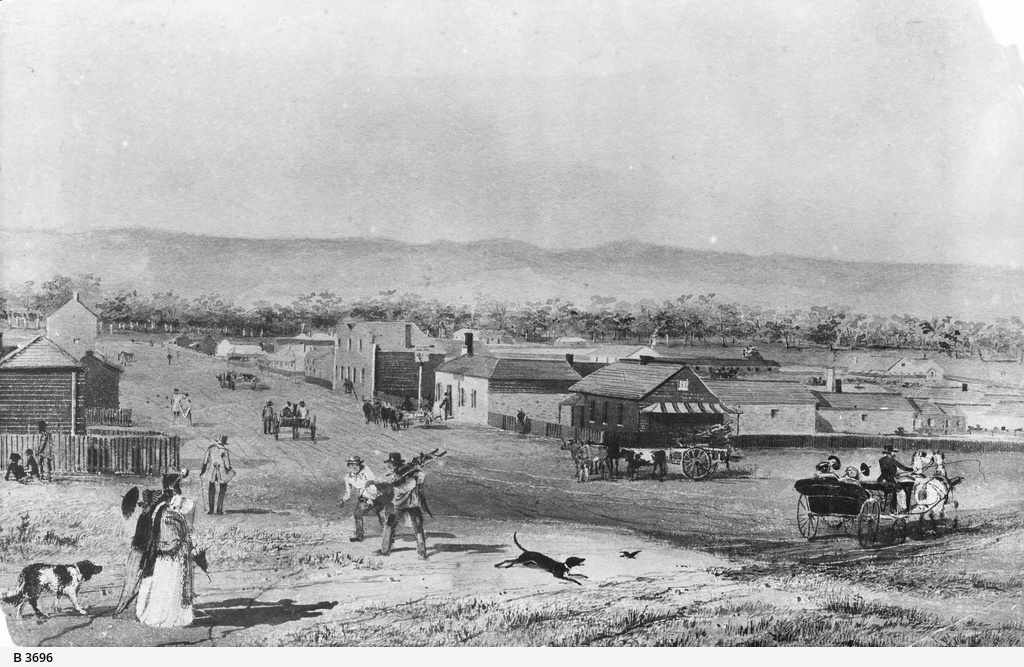
It has always been the habit of those responsible for giving hotels names to show a partiality for animals. From 1837 to 1927 South Australia has produced the following array of hotels so named: —
- The Red Lion
- The Black Lion
- The Black Bull
- The Black Swan
- The Stag
- The White Hart
- The Buck’s Head
- The Maid and Magpie
- The Dog and Duck
- The Buffalo’s Head
- The White Horse
- The Running Horse
- The Kangaroo
- The Hen and Chickens
- The Arab Steed
- The Bull and Crown
- The Boar’s Head
- The Bonnie Owl
- The Goat’s Head
- The Black Horse
- The Green Dragon
- The Dolphin
Many of these hotels are still in existence, but there are some which are altogether unknown today. The Dog and Duck was a popular rendezvous for residents of Payneham about 1840; the Goat’s Head was an early Mount Barker inn; the Bonnie Owl was situated at a place called Wilwyn; the Kangaroo was somewhere on the road to Woodside; the Hen and Chickens was at Port Adelaide; the Dolphin and the Boar’s Head in Bundle street; the Buffalo’s Head in Hindley street; the Bull and Crown at Payneham; and the Running Horse in Wakefield street.
Uncommon Names

While some of the persons responsible for naming South Australian hotels showed discrimination of a sort, there was a class which used its imagination freely. This class produced among others the following: —
- The Grapes Inn (Grenfell street)
- The Gate Hotel (Goodwood)
- The Arcade Shades (Gilles Arcade)
- The Beehive (Currie street)
- The Bird in the Hand (Dry Creek and Rivoli Bay)
- The Coach and Horses (Port road)
- Steamboat Inn (Port Adelaide)
- Rainbow Tavern (Gouger street)
- The Hand and Heart (St. Mary’s Village).
- White Conduit House (North Street, Adelaide)
- The Whalers’ Return (Waymouth street)
- The Saracen’s Head (Walkerville)
- The Plough and Harrow (Rundle street)
- The Horse and Jockey (Carrington street)
- John o’ Groat’s House (Hindley street)
It is interesting to note that in some cases South Australian hotels have been moved from place to place. Many persons will be inclined to think that the location given the Saracen’s Head Hotel in the above table is incorrect, but Walkerville was the home of the original Saracen’s Head, as Currie street was the home of the first Southern Cross. In the early ‘seventies the Rainbow Tavern, situated as it was close to the Supreme Court, was the favored resort of a well-known judge of the period.
One day the proprietor of the Rainbow was hailed before the judge, who on the Bench was noted for his lack of know-ledge of all local slang. In the course of the case, the publican in giving evidence had occasion to mention the word nobbler. “Nobbler?” said the learned judge with a sniff, literally pouncing upon the unfortunate boniface. “What is a nobbler?'” “You ought to know, your Honor.” re-plied the publican like a shot. “Fourpence a time.”
Thick with Hotels
Hindley street, ever since the State was born has had a reputation for its plenitude of hotels, which it has maintained until the present day. There are in Hindley street today 11 hotels, which, is more than any other street in South Australia can boast in the same length. Yet Hindley street today is quite poorly off as regards hotels to what it was at the beginning of the century; Hindley street hotels which have died in recent years are: —
- The Theatre Royal
- The Clarendon
- The Royal
- The Foundry
- The Adelaide
- The Mafeking Hero

Under the law of the land in South Australia it is possible for local option polls to be held every three years, but today’s poll is the first local option poll of any extent which has been held since 1910, when in many districts one-third of the existing hotelkeepers were forced to relinquish their licences. It is not only local option polls, however, which have caused the hotels of South Australia to dwindle from 762 in 1891 to 602 in 1927.
In 1916 there were 108 hotels in Adelaide, and today, though there have been no closures through local option polls, there are only 93. Adelaide hotels which have died during the past 11 years are:—
- The Foundry
- The Royal
- The Adelaide
- The Lady Ferguson
- The Bedford
- The Shakespeare
- The West Terrace
- The Horse and Jockey
- The East Adelaide
- The Wheelwright Arms
- The Clarendon
- The Grand Central
Even though, many famous South Australian public houses have ceased to exist and figures show that the hotels of the State are growing steadily less, South Australian hotels are still a powerful force in the land. In one year it is estimated that the 602 hotels of the State provide weary travellers and wayfarers with something like 1,500,000 beds and 4,000,000 meals. No estimate is available of the number of glasses of liquor they dispense.
Subscribe to the latest Time Gents stories
PAYPAL BAR TIP
If you would like to support my work, you can leave a small ‘bar tip’ here of $2, or several small tips, just increase the amount as you like. Your generous patronage of my work and research, however small it appears to you, will greatly help me with my continuing costs.
$2.00
OR DONATE BY CREDIT CARD
Don’t have PayPal? Instead, you can support my work by leaving a secure $2 debit or credit card donation here, or you can increase the amount after clicking or tapping into the icon below. Your generous patronage of my work and research, however small it appears to you, will greatly help me with my continuing costs and research.
Categories: Adelaide hotels, South Australia Hotels
Brickmakers Arms is in Chief street Brompton
Renamed Gas Light Tavern until 2024.